
This is not an obligation arriving next year. It became applicable on 2 August 2026 and it affects any brand publishing AI-generated or AI-manipulated product images in the European Union. If your catalogue carries AI visuals with no mark of origin, you are already outside it.
The usual confusion comes from three separate things being mixed together: the European legal obligation, the policies of the platforms you sell on, and the labels some tools apply on their own. Three layers, three different parties responsible, and meeting one does not cover the others.
What exactly it requires, and of whom
Article 50 of the European AI regulation splits responsibility in two: whoever builds the tool must embed a machine-readable mark in what it generates, and whoever uses it and publishes must disclose that the content is synthetic. The second part is yours, and it cannot be delegated to your supplier.
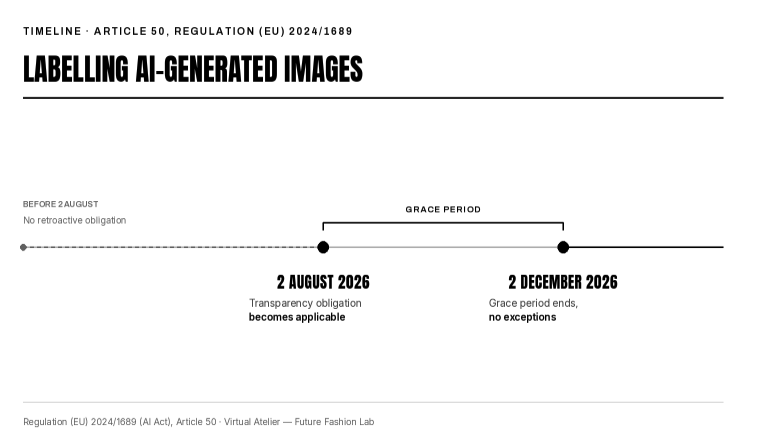
The room that exists is not yours. The deadline of 2 December 2026 is for generators already on the market before 2 August to embed the machine-readable mark: it binds whoever builds the tool, not whoever publishes with it. Your part — disclosing that the image is synthetic — has applied since 2 August, with no adaptation period. The only thing you do not have to revisit is what you published before that date: there is no obligation to label retroactively.
| Date | What happens | What it means for your catalogue |
|---|---|---|
| 2 de agosto de 2026 | Your transparency obligation becomes applicable | Every new AI-generated visual needs you to disclose it as such. The technical mark comes from the tool; the disclosure comes from you |
| 2 December 2026 | Deadline for providers of generators already on the market before 2 August to embed the machine-readable mark | It does not change your obligation: it changes what your tool should hand you. Check that yours does |
| Before 2 August 2026 | Earlier content | No obligation to label retroactively |
What it costs not to do it
The regulation grades fines in three tiers depending on what is breached, and transparency obligations sit in the middle one. The figure that applies is neither the percentage nor the fixed amount: it is the comparison between the two.
| What is breached | Amount | Which one applies |
|---|---|---|
| Prohibited practices | €35m or 7% of worldwide turnover | Whichever is higher |
| Transparency (Article 50 sits here) and high risk | €15m or 3% | Whichever is higher |
| Giving incorrect information to authorities | €7.5m or 1% | Whichever is higher |
There is an exception that matters to most fashion brands more than the whole table: for SMEs the criterion inverts and the lower of the two amounts applies. That is not a symbolic discount: for a mid-sized company it changes the order of magnitude of the exposure. It is worth knowing which side of that line you sit on. la menor de las dos cantidades. No es una rebaja simbólica: para una empresa mediana cambia el orden de magnitud de la exposición. Conviene saber de qué lado de esa línea estás.
Who enforces this in Spain
Brussels is not the one who will call you. The competent authority here is the Spanish AI Supervision Agency, created by royal decree in 2023 and based in A Coruña, acting as market surveillance and single point of contact with the Commission. Oversight is shared with other bodies depending on the sector.
And there is something almost nobody is using: the agency has published FAQs and specific guidance on Article 50,in Spanish, on how to identify and label AI-generated content. It is the most direct source there is for resolving a concrete case, and it sits one click away in its resources portal.
A national organic law on AI governance is also going through parliament. It does not transpose the regulation — it applies directly — it organises internal oversight and sets out the penalty regime for minor infringements. Until it passes, the European regulation is what applies.
The expensive mistake: assuming the platform's label covers you
Several advertising platforms have added tick-boxes to declare that an asset was AI-generated, and many brands have ticked them assuming the matter was settled. It is not. Those labels serve that platform's ecosystem and its own policy; none of them certifies that you meet the European rule, and some say so explicitly in their own documentation.
Ticking a box in an ad panel is not compliance. It is telling that platform, which is a different thing.
On top of that sits a fragile technical layer: provenance metadata travels inside the file and almost every intermediate process strips it. A crop, a compression on upload to your CMS, a careless export — any of them wipes it without warning. If your workflow passes through three sets of hands, check it survives to the end.
It helps to know exactly what you are looking for, because «the metadata» is not an instruction anyone can act on. The IPTC field is called DigitalSourceType and, for an AI-generated image, the value it must carry is TrainedAlgorithmicMediaGoogle requires it in Merchant Center and warns against stripping it from images made with generative tools. The distinction from the opening applies again: that is platform policy, not European law. They converge on the same technical field — which is why you check it once — but meeting Google's requirement is not meeting Article 50.
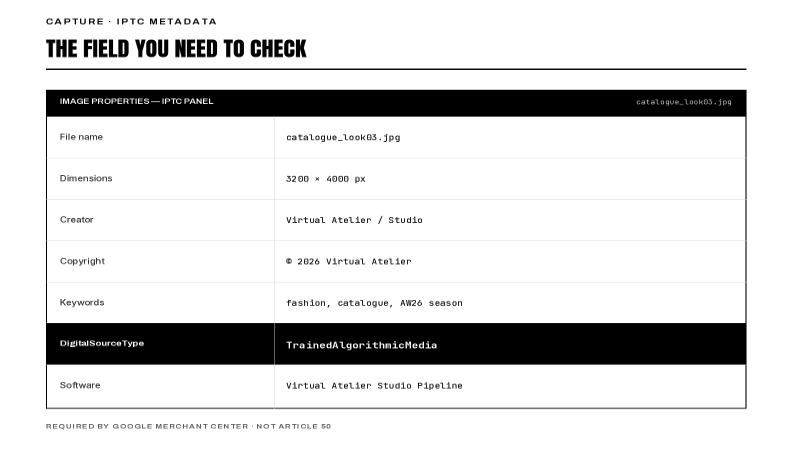
IPTC metadata panel with the DigitalSourceType field highlighted, value TrainedAlgorithmicMedia
What to review in your catalogue this week
Start with the inventory, not the fix: which live images carry AI, which channels they sit on, and which still hold their metadata. Without that map, you are deciding blind.
- Separate fully AI-generated images from photographed-and-AI-retouched ones: they are not the same case.
- Check whether your CMS preserves metadata on upload, because many strip it while optimising.
- Decide where the user-facing disclosure goes and in what words, and write it once for the whole brand.
- Name the person responsible inside the team. If it has no name, it does not get done.
One warning on scope: the European rule is not the only one in play. There are markets outside the Union with their own requirements on synthetic imagery in advertising. If you sell across several, your standard has to be the strictest of them, not the one where your head office sits.
Transparency here is not a toll. It is the difference between a brand that decided how to tell this and one that had it told for them. And that decision no longer admits waiting: the obligation has been in force since August.
This article explains the general framework and is not legal advice. Before applying anything to your catalogue, check it with your own legal counsel.
| This article reflects the state of AI tools as of September 2026. Given the pace of change in the sector, some of the features or tools mentioned may have changed since then. |